
How to Get Court Records
Start by naming the court and the exact document you need. In Stonewall County one person holds both jobs. Holly McLaury serves as District Clerk and County Clerk, and the office goes by District / County Clerk. The counter is shared, but the files stay separate. District records cover 39th Judicial District Court civil, family, felony, and district juvenile matters. County Clerk files are different. They hold constitutional County Court civil, criminal, probate, mental-health, and reported county juvenile cases.
- Search the county-linked LGS index for the cause and any public image.
- Check re:SearchTX as a statewide supplement for district or county information.
- Call the combined clerk office to confirm custody, access, fees, and payment.
- Visit the clerk counter during posted hours for inspection or copy service.
- Mail a focused request with the court, cause number, document, and delivery choice.
- For other judicial records, send a written Rule 12 request to the actual custodian.
Call before you drive or mail anything. Ask whether the clerk can email a noncertified copy, whether certification is required, and whether the portal leaves out the image. The Stonewall County case search can surface the cause number first.
Stonewall County Court Records Clerk
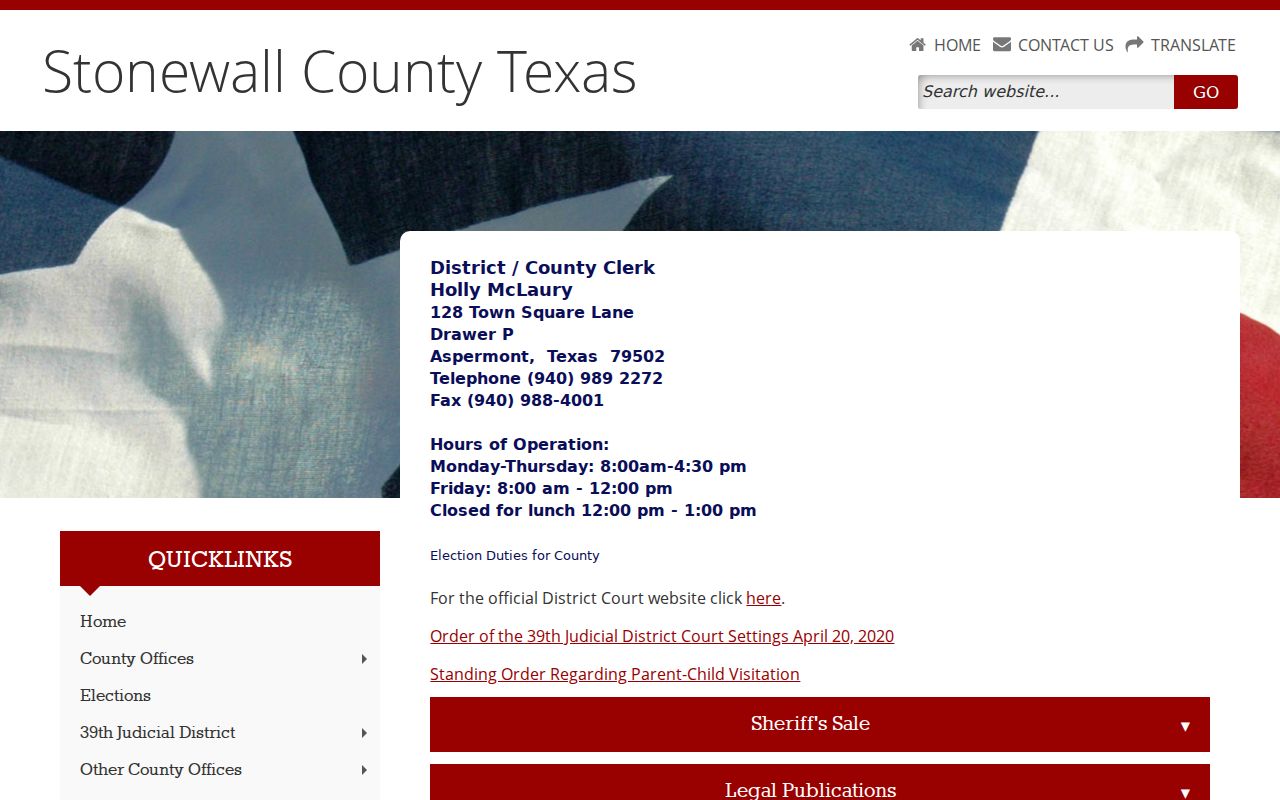
The official District / County Clerk page lists the main records contact. Visit at 128 Town Square Lane, or mail to Drawer P, Aspermont, TX 79502. The phone is (940) 989-2272. Fax is (940) 988-4001, and email is holly.mclaury@stonewallcountytx.org. Hours run Monday through Thursday, 8:00 a.m. to 4:30 p.m., and Friday, 8:00 a.m. to noon, with closure from noon to 1:00 p.m. The clerk page also displays the local gateway that serves both clerk functions.
Tell the office the court name, the rough filing year, the category, the cause number if known, and the exact document. That short list lets the clerk tell an index search apart from copy production.
Stonewall District / County Clerk
Holly McLaury
128 Town Square Lane, Drawer P
Aspermont, TX 79502
(940) 989-2272
Types of Court Records
A docket is the list of events in order. The case file holds the pleadings, motions, notices, orders, judgments, and other filed papers that stay public. Stonewall County court records span several court levels, so name the category you need.
- District civil, family, felony, and district juvenile records
- County civil, criminal, probate, and mental-health records
- Justice Court small claims, eviction, traffic, and fine-only records
- Aspermont municipal ordinance and Class C case records
- Public orders, judgments, settings notices, and clerk certifications
Deeds, liens, brands, marriage records, and vital records are not court cases just because the County Clerk files them. A property dispute may produce a court file. The deed itself still lives in the recording system.
Stonewall County Court Record Layers
The LGS search may offer an index row, a More Information tab, and an Images link. Each layer answers a different question. The index locates the cause. The image lets a reader inspect one public document. A certified copy, which authenticates a document for legal use, must come from the clerk, since public image coverage is far from complete.
| Record Layer | What It Does | What It Does Not Prove |
|---|---|---|
| Index | Locates a cause and basic fields | That every document is online |
| Portal image | Displays an available public filing | That the copy is certified |
| Clerk copy | Provides the selected document | Certification unless requested |
| Certified copy | Adds the clerk's certificate and seal | Anything beyond the certified record |
Say "certified" in plain words. A screen print or a portal download never becomes certified, no matter how official it looks.
What a Court Record Contains
Public Stonewall County court records can show who a cause involves and where it stands. The content varies with the court, case type, filing date, and access rule. A search result may show only fields even when the clerk holds much more.
| Cause number | The unique identifier assigned by the court. |
|---|---|
| Case style | The formal caption used by the court. |
| Court and judge | The court that owns the file and assigned judicial officer. |
| Filed date | The date the cause entered that court. |
| Events | Filings, service, settings, orders, judgments, or dispositions. |
| Document status | Available, restricted, pending, or another portal label. |
A status of disposed only means the matter left the active workload under the court's reporting rules. It is not the judgment. The signed order states the actual result.
Written Stonewall County Court Record Requests
Courts and judicial agencies are not treated like executive agencies. That is the rule under the Texas Public Information Act. Texas judiciary policy sends access to adjudicative case files through the clerk. It governs other judicial records through Texas Rule of Judicial Administration 12 and other law. A Rule 12 request must be written, specific enough to identify the record, and sent to the right custodian. Ask to inspect or get a noncertified electronic copy of one public document. State the court and cause number, plus an approximate filing date. If the cause number is unknown, give only the limited facts needed to locate the cause. Never email Social Security numbers or account numbers. The same goes for medical details or other private data the request does not need. Rule 12 calls for a response as soon as practical and no later than 14 days. The response either provides access or gives a delay notice and a reasonable production date. A denial carries a review process. These rules still do not guarantee release of sealed or exempt material.
Certified Copies and Fees
Texas Government Code Chapter 51 frames how clerks set charges. The real total may combine pages, certification, search work, mail, processing, or another provision. Confirm the amount and payment method with the Stonewall clerk before sending funds.
| Service | Statutory Reference Amount |
|---|---|
| Search without docket number | $5 |
| Certificate and seal component | $5 plus applicable copy charge |
| Electronic copy, up to 10 pages | $1 |
| Electronic pages above 10 | $0.10 per page |
| Abstract of judgment | $8 |
The county LGS FAQ lists free searching, a $0.30 transaction fee per image purchase, and subscription amounts that vary. Portal costs are not the clerk's certification fee.
Stonewall County Court Records Offline
A missing image can mean several things. The document may not be exposed online. It may predate an integration, may be restricted, or may sit in another court's system. None of that proves the record never existed. The county's local case-management system is LGS. re:SearchTX integration has changed statewide over time. The official County Clerk page gives the online-record link and local instructions.
No image means you ask the clerk for the exact filing. Justice Court and municipal files sit with those lower courts, so go straight to the court named on the papers.
Public Access and Sealed Records
Texas court records start open. Rule 76a of the Texas Rules of Civil Procedure presumes public access. Yet a judge must order sealing for a stated reason first. Rule 12 governs other judicial records and shields a defined set. That set covers judicial work product, security plans, internal deliberations, certain personnel data, and private future calendar entries. It also covers anything law makes confidential.
Key access rules:
Texas Rule of Civil Procedure 76a governs sealing of covered court records.
Rule of Judicial Administration 12 governs access to many other judicial records.
Texas Government Code Chapter 552 points judicial access toward court rules and other law.
Expect tighter limits on juvenile, child, family, protective-order, mental-health, probate, and guardianship files. Even public documents may mask identifiers and private facts. Request only material the law opens to you.
Stonewall County Court Record Structure
The Texas judiciary's court structure page gives the official statewide layout of District, County, Justice, and Municipal Courts.
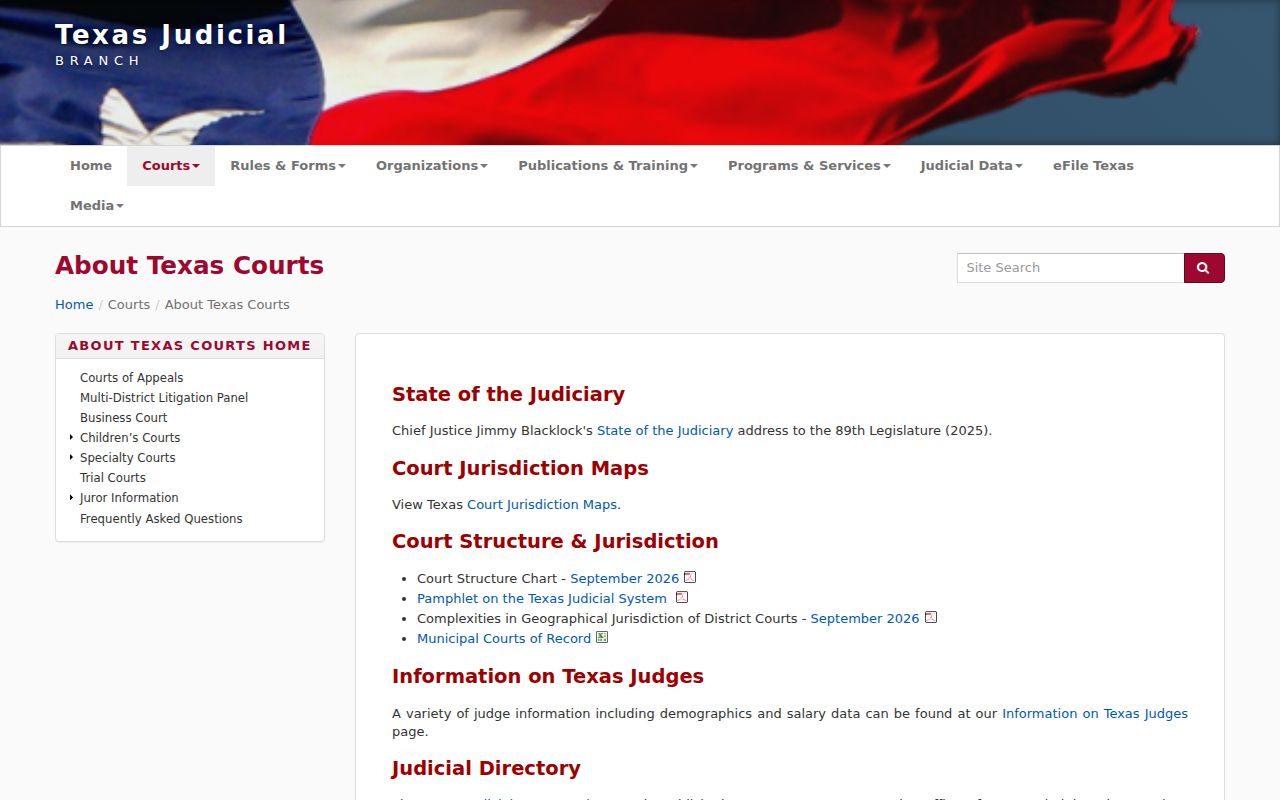
That hierarchy matters. A single Stonewall dispute can leave records in a local trial court and, later, a separate appellate docket. For a verified copy, ask whichever office holds the original file.
Stonewall County Probate Court Records
Probate and guardianship files can hold protected medical, financial, minor, or guardianship material. The public index may list a cause yet keep the documents back. Ask the County Clerk which Stonewall County court record is open and in what copy form.
Stonewall County Justice Court Records
Small claims, evictions, traffic, and fine-only cases live in the countywide Justice of the Peace court, within its authority. If the citation or pleading names that court, call it. Don't assume the combined clerk has the original.
Stonewall County Appellate Court Records
Stonewall County appeals go to the Eleventh Court of Appeals on its own docket. That record may carry a new cause number, briefs, an opinion, and a mandate. The trial documents stay with the trial court that first received them.