
How to Search Criminal Dockets
Look first at any notice, bond paper, citation, or prior order. It names the court. Felony records in Stonewall County travel the 39th Judicial District Court path. The constitutional County Court handles county-level criminal matters. Fine-only cases may sit with the countywide Justice of the Peace or Aspermont Municipal Court. Holly McLaury's combined office is what the county calls the District / County Clerk. One person wears both hats, yet the legal files stay tied to separate courts.
The LGS Online Records Search serves as Stonewall County's main local index and image route. Searching costs nothing. Plug in the cause number if you have it. Guest access shows index details and previews. Buying available images takes an account. Otherwise, use a name or case style. Pair it with an approximate year, the right office, and a criminal record type.
- Identify the Stonewall County court printed on the case paper.
- Open LGS and choose the matching office and record type.
- Search by cause number first, or narrow a name search by year.
- Open “More Information” and review events, status, and images.
- Contact the clerk for missing images or a certified copy.
Stonewall Criminal Court Routes
Picking the wrong tier trips up many local searches. The Texas court directory lays out Stonewall County's compact structure. A felony indictment is a district record. Criminal work reported by Stonewall County Court belongs at the county tier. The countywide Justice of the Peace handles traffic and other fine-only proceedings within its authority. Aspermont's municipal function covers ordinances and Class C matters. It posts no public docket.
| Court | Criminal work | Start here |
|---|---|---|
| 39th District Court | Felony cases | District Clerk and LGS |
| Stonewall County Court | County criminal work | County Clerk and LGS |
| Justice Court | Traffic and fine-only cases | Justice of the Peace |
| Aspermont Municipal Court | Ordinances and Class C cases | City Hall |
What a Criminal Docket Shows
Think of a Stonewall County criminal docket as a dated register, not the whole file. LGS results may include index data, a "More Information" option, and an Images link. The statewide field model uses labels like location, category, filed date, status, parties, and events. An image link means a document may be available. It does not promise that the image is complete. It may be restricted or uncertified.
| Cause number | The court's unique key, shown here as [court-assigned number] because no local format was verified. |
|---|---|
| Court and category | The Stonewall County court and criminal classification. |
| Charge | A complaint, information, or indictment, based on court and offense level. |
| Events | Filings, arraignments, motions, pleas, hearings, and resets. |
| Disposition | The recorded result or resolution status. |
| Documents | Pages, price, availability, or restriction where supplied. |
Never lean on a short status label alone; read the filed order or judgment first. A charge is an accusation, and a docket event can be followed later by a correction.
Stonewall Criminal Access Layers
Stonewall County leans on systems with different jobs. LGS supplies the local index and images. re:SearchTX works as a statewide research layer for integrated courts. eFileTexas receives filings. But it is not a complete public docket, and the state citations portal deals with legal notices rather than an ordinary criminal case lookup.
The state's 2024 data report said the central re:SearchTX document collection then excluded criminal case records. It also described later integration work. So a blank statewide result proves nothing about whether a Stonewall County case exists. Check LGS first, then call or visit the right clerk. Mail, fax, and email are published contacts, though Stonewall County promises no set delivery method or turnaround.
Local-first rule: Treat re:SearchTX as a supplement. The Stonewall County clerk and local index remain the best sources for completeness and certification.
Stages on a Criminal Docket
A felony docket often opens with a charging event or indictment. It then moves through arraignment and pretrial settings. Motions and orders can follow. A plea or a trial may then lead to a disposition. Sentencing appears as its own event. Fine-only dockets run differently. They can show a complaint, citation, plea, setting, payment, deferred disposition, judgment, or warrant-related event.
Stonewall County docket flow: Filing › Arraignment › Pretrial › Plea or Trial › Disposition › Sentencing
- Arraignment
- The charge is stated and a plea or response is addressed.
- Setting
- A scheduled event that may be reset.
- Disposition
- The recorded result or resolution status.
- Capias
- An order directing law enforcement action; an old entry does not prove current status.
Stonewall Fine-Only Docket Rules
Code of Criminal Procedure Chapter 45A governs justice and municipal criminal proceedings. It sets rules for complaints, pleas, notices, and failure to appear. It also covers appeals, fines, and deferred disposition. A complaint must carry required formal parts. This official source shows the law shaping Stonewall County fine-only docket events:
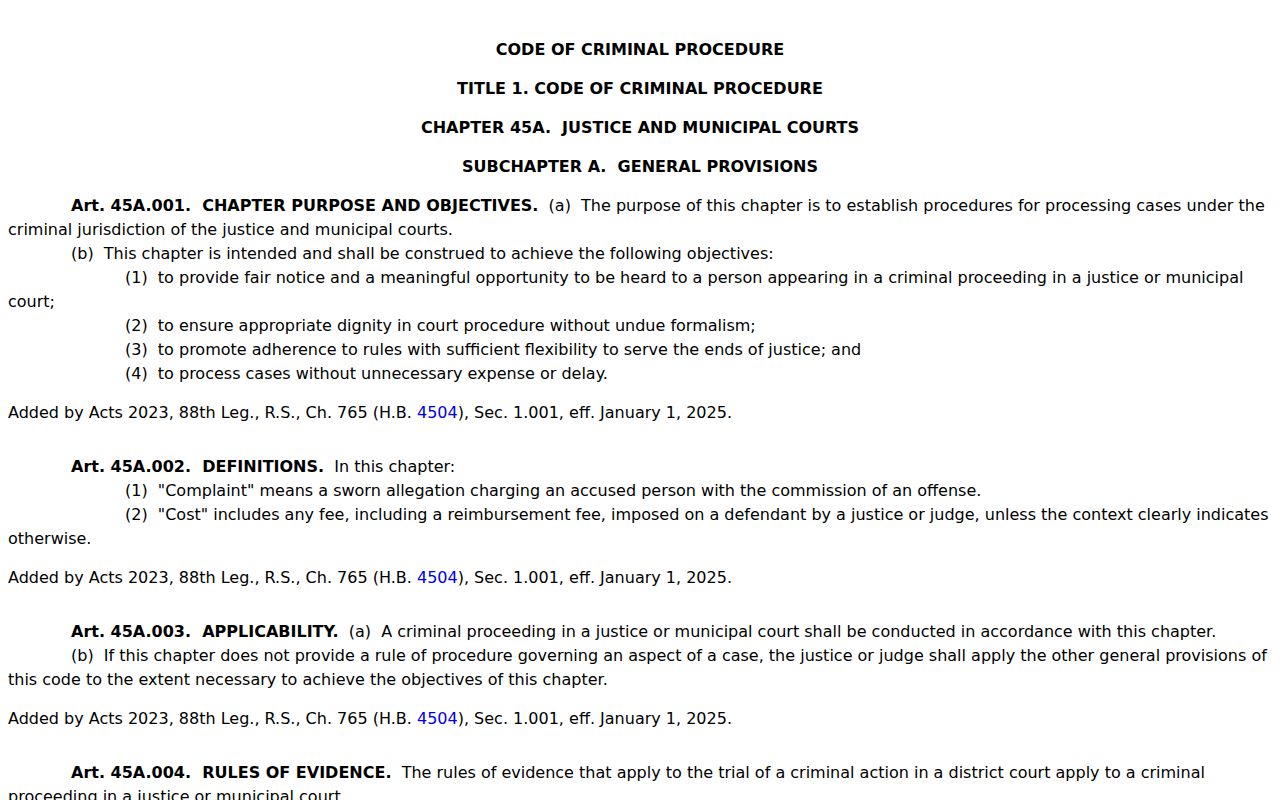
That statute explains why a lower-court docket may list a notice, plea, deferred disposition, or failure-to-appear step rather than a district indictment.
Which Court Holds Criminal Dockets
The 39th Judicial District spans Haskell, Kent, Stonewall, and Throckmorton counties. Its judge and staff work out of Haskell. Stonewall County district files still run through Stonewall's District Clerk, though. That affects where a setting notice originates. It does not move the local file into another county.
County-level records go to Holly McLaury in her County Clerk role. Darla Pearson is the countywide Justice of the Peace in the current directory. Municipal matters go to the court printed on the citation. For Aspermont Municipal Court, City Hall should identify the current clerk. No public docket portal is posted.
Stonewall Justice Criminal Workload
The FY2025 OCA reports offer context, not names. Stonewall County's Justice Court began with 110 criminal matters active or pending, added 59, disposed of 54, placed 17 on inactive status, and ended with 88 active or pending. The report covers September 2024 through August 2025 and uses a 2024 population of 1,235.
These are workload counts, nothing more. They describe no felonies, prove no trend, and identify no person. "Inactive" is a reporting term, not a dismissal.
Public Access to Criminal Dockets
A Stonewall County criminal docket is public, but only up to a point. Sealed material, protected child data, and restricted images can be missing from the index. Filing standards also force redaction of sensitive data before anything goes public. License numbers, Social Security numbers, financial accounts, birth dates, and home addresses get stripped out. Chapter 45A adds protection for child records in fine-only cases. Its traffic exception still applies.
Key access rules:
Texas Rule of Judicial Administration 12 governs many non-adjudicative judicial records.
Texas Rule of Civil Procedure 76a supplies the civil sealing framework.
Chapter 45A addresses lower-court procedure and child-record confidentiality.
A sparse index line or missing image settles nothing. Check with the clerk before reading it as proof of a case outcome.
Stonewall Criminal Copy Fees
Searching an index, pulling a portal image, and ordering a certified copy are three different services. Each carries its own cost. Government Code Chapter 51 lays out what clerks may charge, including a search fee when no docket number is supplied, plus separate copy and certification parts. That statutory reference appears on the official page itself:
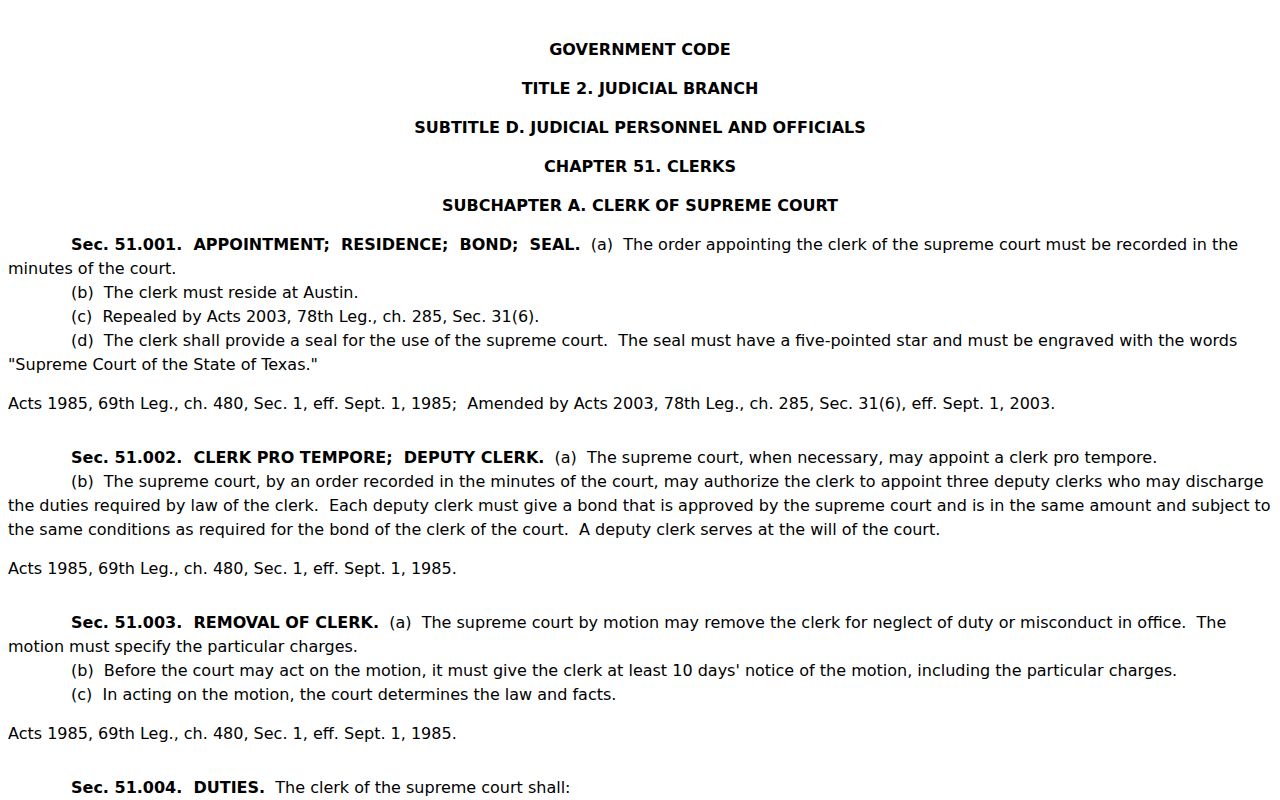
Treat the statute as a price list, not a guaranteed total. Search, page, certification, mailing, and payment costs all vary, so ask the Stonewall County clerk for the real numbers. Government Code Chapter 27 sets Justice Court jurisdiction, and its official text shows which lower-court cases belong in that tier:
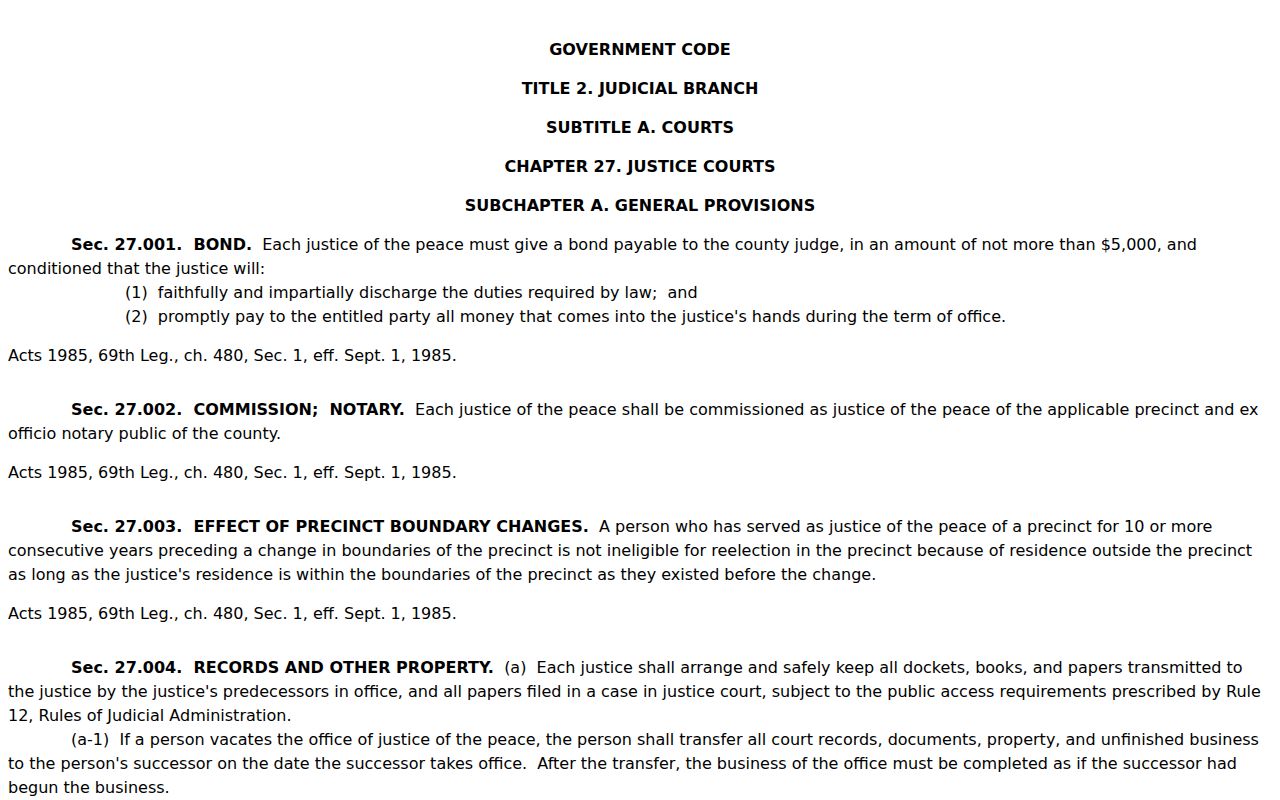
Jurisdiction tells you where a docket lives. It cannot replace clerk confirmation of a specific Stonewall County case.
Stonewall Criminal Docket Requests
The local index may skip a public filing you need. Send a focused request to the right office. Name the Stonewall County court. Add the cause number if known. Give an approximate filing date, and describe the exact document. Say whether you want inspection, a plain electronic copy, or a certified copy. Skip license numbers, financial data, and any personal detail the clerk does not need.
Rule 12 governs many judicial records outside an adjudicative case file. For an indexed criminal case, a clerk request is still the practical first route. The office posts weekday hours along with mail, phone, fax, and email contacts. Ask which channel the clerk accepts. Ask also what fee may apply for the Stonewall County record you want.